The Master’s Hand - Framing SprintFounders Edition
In Just Four Thrilling Weeks With Kenrick Cleveland, Learn To Make People See Their Own Deepest Motivations Inside Your Offer
(With The Touch Of The Master’s Hand, You Can Sculpt Any Offer You Dream Up Into The Very Form Of Their Own Desire.)
And Kiss Goodbye To Reactionary Reframing, Pain-Pushing, And Ever Again Landing On The Wrong Side Of Too Aggressive Or A Pushover

By Kenrick Cleveland
Pioneer of influence psychology. Forty-five years looking for the fire at the core of persuasion, and he found it in framing.
Continue On This Page To Learn Why Framing Is The Highest‑Leverage, Least‑Effort Skill You Can Develop… And Why It Makes Or Breaks Every Other Move In Your Arsenal
“The Touch of the Master’s Hand”
by Myra Brooks Welch
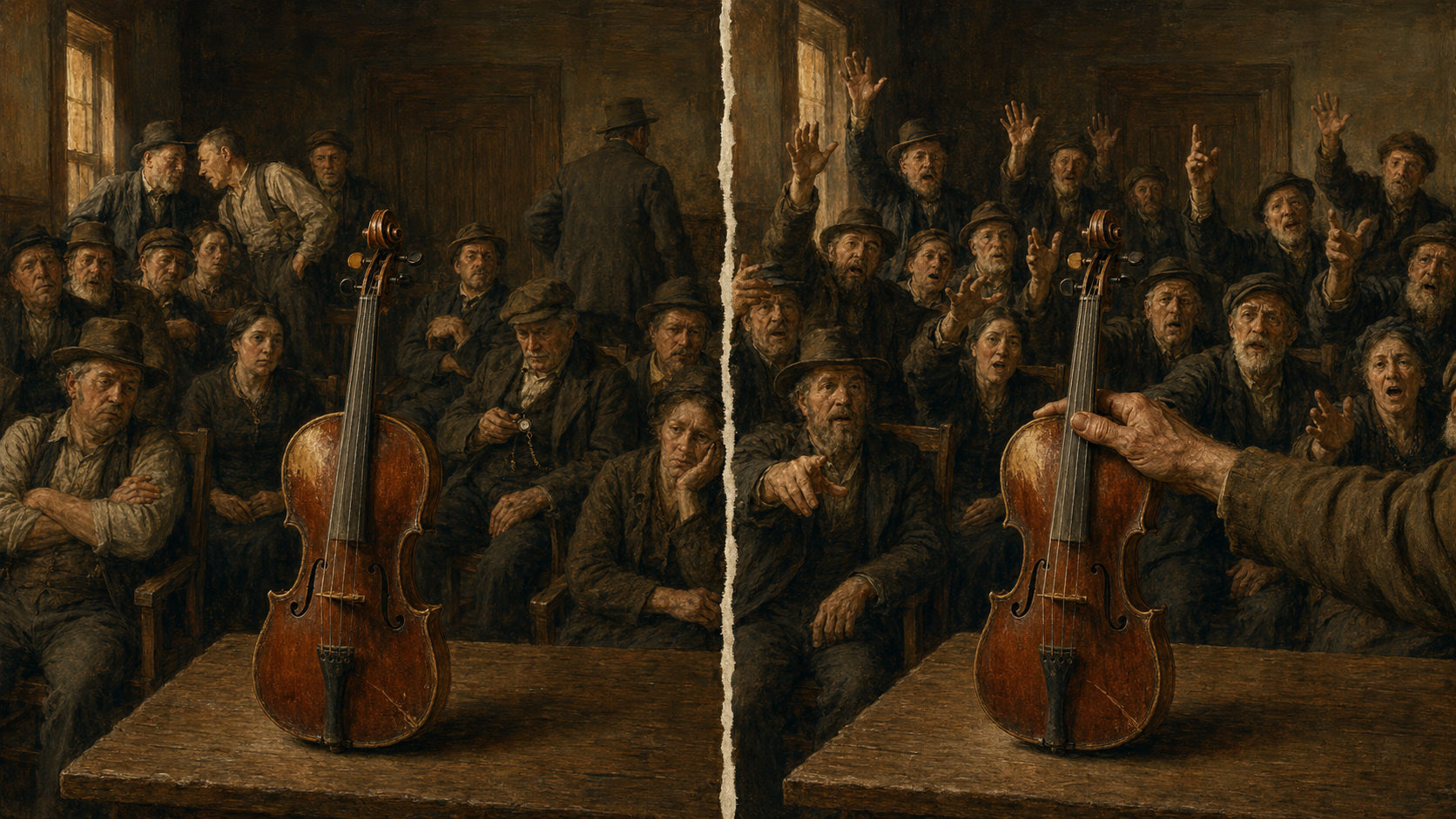
This Was Written For You, Because It’s About You
This was written for you…
…because it’s about you.
You’re here because of one conversation.
…One you thought went well.
…One you’d have put money on.
They had the budget.
They had the exact problem you solve.
…And you’d already watched people in worse shape, with thinner budgets, say yes to work considerably worse than yours.
This one said they’d think about it.
So you went back over it afterward.
…Maybe you pulled the recording.
…Maybe you sat in the car for ten minutes and ran the whole thing again from the top.
And you couldn’t find the place where it broke.
There’s no moment to point at.
Nothing went wrong, exactly.
…Which means…
You’ve got a problem.
And you don’t have a name for it.
…You’ve got a leak.
And you don’t have a place to look.
And it wasn’t the offer.
The work you always do. The value that was always sitting in it. The words that had worked on everybody else that month.
…So the offer can’t have been the problem.
Something else settled that conversation before you ever got to the part you rehearsed.
…Something that was already in the space when you sat down.
…Something you didn’t set, didn’t hear, and have never once been trained to look for.
A sleight of hand happens in front of you every working day of your life.
…Now the deal is alive,
and now it isn’t…
…Now they’re ready to buy,
and now they’ve gone ghost.
And every single time, you go looking in the same four places.
The pitch.
The price.
The timing.
Yourself.
It was never in those four places.
Because an offer has no value of its own.
…It only ever has the value of whatever it’s being seen through.
And somebody set that.
…It might have been the vendor who was in there before you.
…It might have been a bad quarter, or a bad hire, or the last person who sold them something that didn’t work.
…It might have been two lines in a calendar invite typed by somebody’s assistant.
It just wasn’t you.
You arrived second.
And you’ve been arriving second your entire career, in every deal you won and every deal you lost, without anybody ever telling you there was a first.
So take a breath, because in the next few minutes I’m going to show you the layer all of this happens on…
…and the laws that put you there first, before anyone speaks.
An offer has no value of its own. The frame each person sees it through … that is where value is made or lost.
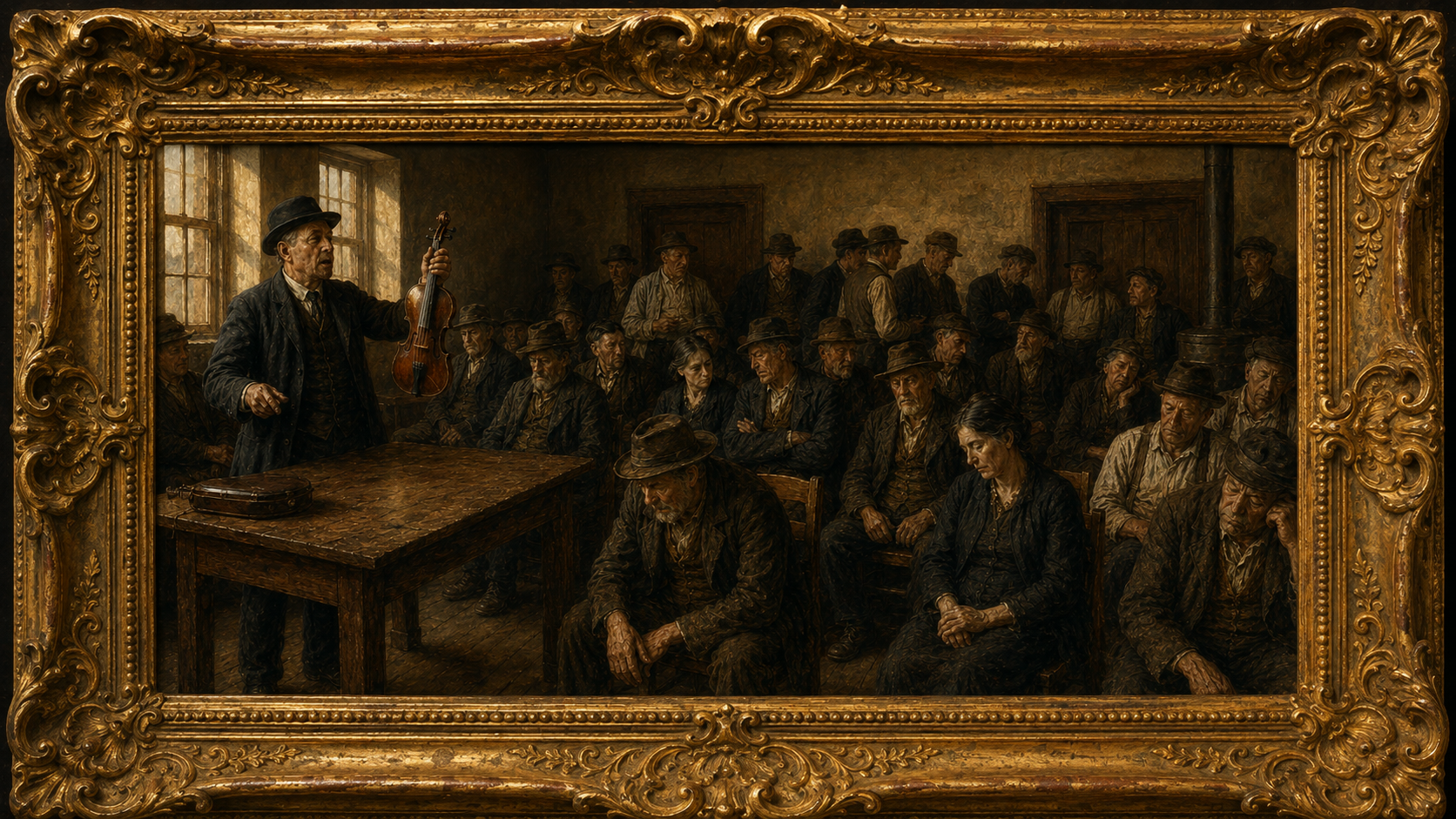
A Frame Decides What’s Real, And Nobody Argues With What’s Real
Go back to that auction for a second.
Before a single bid was made, the auctioneer had already settled what everybody in there was looking at.
…An old violin.
…Battered and scarred.
…Scarcely worth his while.
Nine words. Then he held the thing up.
That was a frame.
Not the words.
What the words made available.
A frame is a window onto reality.
Whatever it happens to be pointed at is what the other person takes the situation to be.
…And nobody argues with the situation.
…They bid inside it.
Which is why that whole room went to three dollars without one person in it feeling pushed, or handled, or sold to.
They weren’t resisting anything.
…They were looking through the only window they’d been given.
So there are only ever two positions available, and you are always standing in one of them.
Either you set the window, or you’re looking through one somebody else set.
Proactive or reactive.
There’s no third position and there never was.
And this is the part almost everybody has backwards.
…What gets taught as framing is nearly always reframing.
…Arguing with a window that’s already up, while they’re standing at it looking through it.
It can be done. It’s far harder than it needs to be, and they can feel you working.
The old man never argued with anything.
…He set a new window, and he did it without saying a word.
And that’s the turn.
…A battered old fiddle nobody in the hall would take home,
worth three dollars at ten past the hour.
…Three thousand at twenty past,
with the dust still on it.
Nobody touched the violin. Somebody changed what the hall was listening for.
Nothing about the violin changed.
The window changed.
That’s the art of it.
A window so agreeable that nobody experiences a window at all.
…They experience the truth.
…And they experience it as their own.
In the auctioneer’s hand it was hardly worth a glance. In the Master’s hand, the same violin became a portal into a moment nobody in that room ever forgot.

Every Other Skill In Influence Is Something You Do AFTER They Went First
My name is Kenrick Cleveland, and I want to tell you how influence has been taught for as long as anybody has taught it.
I’ve spent forty-five years in persuasion and influence.
…I’ve taught closing.
…Objection handling.
…Rapport.
…Tonality.
…Story.
…Language patterns.
Every one of them real. Every one of them useful. I put several of them into shape for this industry myself, and I’d teach most of them again tomorrow morning without blushing.
And every single one of them is a move you make after the ground has already been set by somebody else.
That is not a criticism of my own work. It is a description of the whole field.
…Closing, objection handling, rapport, tonality, story, language patterns. Every one of them is something you do once somebody else has already decided what the conversation is about.
That is reactive influence, and reactive influence is the entire business. Not my corner of it. The business.
Which is why the same sentence has come back to me decade after decade, from people who did the work exactly as it was laid out for them.
“I did it exactly the way you showed me.”
And they had. That is the part that mattered.
I’d watch a recording and hear a person execute technique cleanly, all the way through, and lose.
…And I’d go looking in the same four places everybody looks.
…And find nothing, over and over again, for years.
The closest thing I’ve ever had to a teacher on this wasn’t a teacher at all.
It was a poem, written in 1921 by a woman named Myra Brooks Welch, about a battered violin, a country auction and an old man who picked it up.
Three dollars before he touched it.
Three thousand after.
And it isn’t a poem about talent, which is what almost everybody takes from it.
It’s a poem about the instant the meaning of something gets decided, and about who is standing there when that happens.
That’s the day I stopped looking at technique.
Because the auctioneer wasn’t a bad auctioneer. He wasn’t careless. He simply went first, and once he’d gone first, nothing anybody in that hall did afterward was going to be worth more than three dollars.
And here is the distinction that reorganised everything for me.
There is the form a moment takes.
And there is the forming force that makes it take that form.
Every skill this industry sells you operates on the form. Framing is the forming force.
…It was always running. Pieces of it were already sitting inside the frameworks I built, working, doing their job, never once named out loud as the thing that made the rest of them work.
…Once you name it, it stops being an accident you got right on your good days.
This is ground zero of influence.
Everything else is built on top of it, and nothing you put up there can perform better than the ground underneath will allow.
Forty-five years in, it’s still the part of this work that lights me up. Not because it’s clever.
Because it’s the one that decides whether anything else you do gets a hearing at all.
If a person only ever learns one skill in influence, this is the one. Not because it beats the others. Because it’s the layer they all run on.

Yes, The Most Powerful Skill In Influence Was Never Really Mapped
Which raises the obvious question, and it’s exactly the right one to ask.
Then why isn’t everybody already teaching it?
Here’s the answer, and it’s stranger than you’d expect.
The frame you’re standing inside operates on three rules, and it has run on them in every conversation you have ever had.
Rule one: it goes first.
Before the pitch. Before the greeting. Before you shake a hand or open a document. By the time anybody speaks, a window is already up, and whoever put it there is the only person in the exchange who is not reacting.
Rule two: it leaves no evidence.
A frame has no words of its own. You can’t point at it in a recording and say there, that’s the bit. The most powerful thing in the entire conversation happens without leaving a mark on the transcript.
Rule three: the credit goes somewhere else.
So you blame the price. Or the timing. Or the market. Or yourself, at two in the morning, which is where most people land.
And that isn’t bad luck.
The most powerful rule in any system is the one every other rule flows out of, and a rule that everything flows out of never shows up as a step you take.
…It shows up as the conditions everything else is happening inside of.
So it doesn’t look like a technique.
…It looks like the weather.
Now here’s the part that reframes the whole field, and once you see it you can’t unsee it.
Reframing, the tool nearly everybody in this business reaches for, didn’t come out of business at all.
It came out of the therapy room.
Think about what that means for a second.
In a therapy room, the client walks in with a frame already built…
…and walks in asking for it to be changed.
…They booked the appointment. They paid for the hour. They came to be moved.
A buyer has never once done that.
Not in the history of commerce.
And that single transplant, a therapeutic tool carried into business unchanged, is the reason persuasion has felt like pushing uphill for two generations of people who were doing everything right.
Reframing is genuinely powerful. I use it. It just starts after somebody has already spoken, which means it was never the half where you go first.
Add the other two reasons and the picture is complete, and not one of them is that people are fools.
People already do it. By accident, in flashes, on their good days. The most persuasive person you’ve ever watched was setting frames the whole time and couldn’t have told you that’s what they were doing. Something you already pull off without naming doesn’t register as a thing that needs teaching.
And the rest of us went after the components. I listed mine a moment ago. Real skills, all of them, all sitting on top of framing, which is how a field maps everything except the one layer everything else stands on.
Put those together and you have exactly where this has stood for as long as anyone has studied influence.
Framing as a concept is everywhere. Everybody nods at it.
Framing as a repeatable skillset, with laws, in an order, that you can run on purpose in a real conversation, has never once been mapped.
Until now.
Everyone has always known that frames matter. Nobody could tell you how to set one on purpose.

What Happens The Day You Stop Arriving Second
Here is what actually changes, in plain terms.
You set the ground before anything else happens, and the conversation takes a different shape from the first minute of it.
You walk into something and set what it’s about, using nothing but material the other person handed you, which leaves them nothing to push against.
Your offer stops arriving naked. It arrives inside a context that already makes sense of it…
…which means the price is heard as a pathway to their desire rather than as a number…
…which means you’re not defending it…
…which means you stop talking after you say it, because there’s nothing left hanging that needs covering.
Objections don’t get handled.
They don’t form.
There’s nothing sitting there for them to object to, which means the conversation gets shorter rather than longer, and you stop having to be on.
You can tell, in the moment, whether what you said landed or whether they were being polite.
You’ve never had an instrument for that. Its absence is the reason twenty years of doing this hasn’t stacked up the way twenty years should.
You get somebody answering from the part of them that can say yes, instead of the part that’s standing guard against you.
And because they arrived at it inside a window that felt like their own, they own the decision.
Which means they stay.
They show up, they do the work, and they’re not reading the refund policy in week two.
The proposals stop getting the warm reply that goes nowhere.
The conversations you were dreading turn out to be about the thing you wanted them to be about, because you settled that before anybody sat down.
And people start talking themselves into it, which is a very different experience from pushing, and a considerably cheaper one.
And you stop losing the ones you can’t explain losing.
The ones where you were good. Where you can hear on the recording that you were good. And it went sideways anyway.
And it works the same on paper as it does in person.
A frame set on a page does to a reader what a frame set in person does to a buyer. The laws don’t change and neither does the order they run in.
…A proposal.
…An email.
…A launch.
…A negotiation.
…Anything you walk into.
And once you can see it, you can’t stop seeing it.
You’ll spend the rest of your life watching other people set frames on you, badly.
You stop trying to be convincing. It stops being necessary.

Here’s Where This Shows Up In Your Week
Laws are worth nothing until you can see where they go.
So here’s where they go.
The price conversation.
Ordinarily the number lands and the other person decides what it means, which is a coin toss you’re not part of.
Set the ground first and the meaning is already sitting there waiting when the number arrives. They hear what it’s been costing them to not have this solved. The number lands inside that, and it reads as small.
The proposal that goes out without you.
You won’t be in the building when it’s read. The frame is the only thing that travels with it.
Set it on page one and the person reading page four is reading it inside your context, at their desk, alone, with nobody there to argue with.
The negotiation.
Whoever sets the ground decides what counts as a concession.
Most people arrive ready to trade and work out halfway through that they’ve been trading inside somebody else’s definition of the deal. Set it first and every move afterward gets measured against a standard you chose.
The meeting you walk into cold.
There’s a frame in there whether or not anybody put one up deliberately.
…The last vendor set it.
…A bad quarter set it.
…Somebody’s assistant set it in a two-line calendar invite.
Getting there first, inside the opening ninety seconds, is the difference between presenting into a headwind and presenting into open air.
The launch.
An audience settles what a thing is before it settles whether it wants one. Win the first decision and the second one largely makes itself.
And none of it looks like persuading.
That’s the tell.
When the frame is right, the work is invisible, and the person across from you experiences the whole thing as having made up their own mind.
Which, as it happens, is exactly what they did.
…Inside a window you built.
The one who sets the ground never has to win the argument, because the argument is being had on their terms.

It Is One Sequence, In The Order A Real Exchange Happens
So what do you actually do?
Thirty lessons sounds like a library. It isn’t. It’s one sequence, in the order a real exchange actually happens.
You’re not memorising thirty separate things. You’re walking one road, and the laws are the turns on it.
It opens where every exchange opens, before anybody has said anything that matters. You decide what should govern. What this is about, what it gets measured against, and what a good outcome would even be. You build it out of material they handed you, which is why there’s nothing in it for them to argue with.
…That is the part nobody was ever taught, and it decides everything after it.
Then it moves the way a conversation moves. You set the frame out of what already happened. You make their reason the thing that governs. You call forward the version of them that can actually authorise this.
Then it holds. You steer it before it goes sideways. You take the ground back when somebody else opened badly. You refuse a bad premise without looking evasive. You make the thing land so they finish it themselves.
And it ends properly. You read whether it actually landed or whether they were being polite. You hold under real pressure, because pressure always arrives. Then you close the door behind what’s been settled so it doesn’t walk back in a fortnight later.
That’s the road. Thirteen turns in the Core Model, with the whole anatomy sitting under them in the Master.
Which is why the size of it isn’t the problem some may assume it is. You don’t study a road. You drive it, and after a while you stop looking at the signs.
Now, there’s a reaction people have when they see how much sits inside this, and it’s worth heading off, because it gets the thing exactly backwards.
It reads as weight. As something you’d have to work through before any of it started paying you.
The opposite is true, and the reason is density.
Most training in this field is one idea with eight hours built around it.
…The insight.
…Then stories about the insight.
…Then a case study on the insight.
…Then a module recapping the insight.
You can feel it happening while you sit there. Material gets padded because padding is what makes a thing look substantial.
Neither of these models is built that way. Both are compressions, and the Core is a compression of the compression.
Every law in them is load-bearing. Anything that could come out already has.
Which means there’s no runway. You don’t wait until the end to get paid.
The first sitting hands you something you can use in your next conversation. So does the second, and the one after that.
Taken together, with study you actually do, this collapses a learning curve that took me forty-five years to walk.
You’re not being asked to find it. You’re being handed the map of it.
Nothing in here was put there to make it look substantial. All of it is holding something up.

Every Law Comes With Four AI Agents Of Its Own
I know exactly what happens to people who buy training on framing, because I’ve watched it for four decades, and it’s the single reason good material fails to stick.
They learn the laws. They can explain them. They can spot them in somebody else’s recording at speed and tell you what should have been done instead.
Then they sit down in front of their own offer, with the bow in their hand, and think:
yes, but how does any of that apply to this?
That gap has killed more skill than laziness ever has.
And it can’t be closed with more content, which is why nobody has closed it. More lessons just produce more of the same problem.
…The only thing that closes it is something that already knows your situation and can hold the law up against it.
So that’s what we spent the last several years building, and it comes with both models.
Every single law carries four AI agents of its own. Not four for the course. Four for that one law, trained on that one lesson, and useless anywhere else.
A Power Tool. You hand it your actual material and it runs that law against it. Your offer, your page, your proposal. Not an example. Yours.
A Chat Guide. A thinking partner for working the law through in writing, at whatever length it takes, without being taught at.
A Voice Tutor. Real voice, not a chat box. You talk, it answers out loud, and it already knows which lesson you’re asking about, so you never open by explaining yourself.
A Voice Roleplay. You run the actual conversation out loud against a counterpart who pushes back the way people push back. As many times as you want, at two in the morning if that’s when you have the time.
That last one deserves a second.
Nobody has ever been able to practise framing.
…You got one attempt per real conversation.
…Months apart.
…With no way to run it again differently.
Which is most of the reason forty-five years of doing this doesn’t compound the way forty-five years should.
All four run on the context profile you build once inside your account. Your offer, your market, the person you’re actually across from.
Every agent arrives already knowing the situation, so you’re never sitting there translating somebody else’s example into your own life.
Which is what takes something this deep and makes it simple to run.
The complexity stays in the model. It stops being your problem.
Nothing like this exists anywhere in this field. Not because it’s a clever idea, but because it took years to build and nobody else had a reason to.
You’re not left holding the laws and working out where they go. They arrive pointed at your material.

Now There’s A Question Underneath All Of This
It decides which of two doors you walk through, so I’d rather ask it than let you guess.
Do you want all of it?
The Master Model is seventeen lessons, and the Core Model comes inside it, so that’s thirty lessons in all. Every law, what sits underneath each one, why each lands on a nervous system the way it does, and what to do when the ground moves under you mid-sentence.
Which adds up to one thing: command over the root of the meaning people make out of anything you put in front of them.
Or do you want the Core Model on its own?
Thirteen lessons, distilled. Leaner, more digestible, arranged in the order a real exchange actually happens, so you’re applying it from the first sitting instead of studying toward it.
The value already sitting inside your work finally arrives in the ears of the person deciding.
I’m not going to pretend the first one is the noble answer. Plenty of people tell me they want mastery when they want the second thing and feel faintly embarrassed about saying so, and there’s nothing whatsoever to be embarrassed about.
The second thing pays for the house.
Either way, access opens inside the Power Ark platform as soon as you’re in, with every lesson and every agent live on it, and it stays open.
You own the skill instead of renting it from somebody.
Now, about the two prices, because I’ve watched what happens when somebody buys at the very top of what they can carry.
Framing runs on calm.
That isn’t a note about temperament, it’s the operating condition. The person who holds a frame is the one who isn’t scrambling, isn’t rushing the close, isn’t reaching.
Take that away and the laws still work perfectly well. You just won’t be in any state to run them.
So if the Master Model would put you under, buying it would work against the exact thing you bought it for. You’d be studying how to stay unhurried while carrying a payment that hurries you.
I’m not interested in selling you that.
Which is the whole reason there are two.
The Core Model is not a sample, not the first half and not the cheap one. It was built with the same care as the thing it came out of, and it exists for the person who’d feel the Master price.
The Master Model is $997, with all thirty lessons and a hundred and twenty agents.
The Core Model is $495, with thirteen lessons and fifty-two agents..
I’d rather this sit in your hands at a price you can carry than behind a door at the price I’d prefer.
FIG. X
Every Law, And What It Lets You Do
No summaries. Here is every lesson in both models and the one thing each one hands you, so you can see exactly what you are choosing between.
Option one
The Core Model
Thirteen lessons
The procedure. The same body of work, cut by the order a real exchange happens rather than by subject, so you are running it from the first sitting.
$495
5,000 AI credits included
Choose the Core Model- 01Framing, The Controlling Element Of PersuasionYou'll be able to tell, inside the first minute, whether you're in a conversation you can win or one where every good answer you give is making your position worse.
- 02Choose What Should GovernYou'll be able to look at a stalled deal and name what it's currently about, and what it needs to be about instead, before you say a single word toward changing it.
- 03Choose The Handle That Does The JobYou'll be able to pick the one move the situation in front of you actually needs, instead of running down everything you know and hoping something catches.
- 04Set The Frame From What Already HappenedYou'll be able to open on ground nobody can argue with, because you'll be building it out of something they already did.
- 05Make Their Reason GovernYou'll be able to turn what they told you they wanted into the standard the decision gets measured against, so the case for moving comes out of their mouth instead of yours.
- 06Call Forward The Role That Can Create ItYou'll be able to get somebody answering you from the part of them that can authorise the thing, instead of the part that's protecting them from you.
- 07Steer The Frame Before It Goes SidewaysYou'll be able to catch a conversation drifting and correct it in one sentence, before it hardens into the objection you'd otherwise spend twenty minutes handling.
- 08Take The Frame From A Messy StartYou'll be able to walk into something somebody else already opened badly and take the ground back without making anybody wrong.
- 09Refuse Bad Ground Before You AnswerYou'll be able to tell a fair question you should answer plainly from a premise you shouldn't accept, and decline the second one without looking evasive.
- 10Make The Frame LandYou'll be able to put a thing in a way the other person finishes themselves, so they walk out owning the conclusion instead of agreeing with yours.
- 11Read Uptake And MoveYou'll be able to tell whether what you said landed or whether they were being polite, in the moment, while you can still do something about it.
- 12Hold The Frame Under PressureYou'll be able to take a real objection without the ground shifting under you, answer the legitimate part of it, and leave the rest exactly where it was.
- 13No-Free-Retreat And Clean ExitYou'll be able to stop cleanly, so the old explanation doesn't walk back in a fortnight later as though nothing had been settled.
Option two
The Master Model
Seventeen lessons, and the Core Model comes with it
The anatomy. What a frame actually is, why it works on a nervous system, and what is happening underneath every move the Core teaches you to make. Thirty lessons across the two.
$997
12,000 AI credits included
Choose the Master Model- 01What Frames AreYou'll be able to see the structure that had already decided the outcome of your conversations before you opened your mouth in them.
- 02The Biological GatesYou'll be able to tell when somebody has stopped taking in what you're saying, minutes before anything they say gives it away.
- 03The Psychological GatesYou'll be able to set which kind of conversation somebody thinks they're in, and which version of themselves turns up to have it.
- 04The Frame TaxonomyYou'll be able to name what's actually running in an exchange, which is what stops you guessing at what to do about it.
- 05Frame PerceptionYou'll be able to read the frame already governing a room when you walk into it, so you stop being the last person to find out what the meeting was about.
- 06Cognitive FramesYou'll be able to put your case in the format the particular person in front of you can process, instead of the format that convinces you.
- 07Social FramesYou'll be able to make a yes socially safe, so nobody has to pay a standing cost in front of other people for agreeing with you.
- 08Authority FramesYou'll be able to establish standing before you make the case, so your content stops having to carry weight content was never built to carry.
- 09Implicit Frame EmbeddingYou'll be able to set the terms of an exchange without anybody noticing you set them, which is the whole difference between a frame that gets voted on and one that simply becomes the situation.
- 10Frame LockingYou'll be able to make ground hold through pressure and drift, instead of watching it revert the moment the conversation gets difficult.
- 11Frame Alignment And Role AnchorYou'll be able to get somebody carrying your frame after you've left the room, in their own words, to people you've never met.
- 12The Role LeverYou'll be able to shift which role a person is answering from, and watch what they believe about the whole situation reorganise around it.
- 13Frame Architecture Across TimeYou'll be able to build a decision across weeks of touchpoints, instead of trying to win the whole thing inside one meeting.
- 14Frame Seizure In Contested EnvironmentsYou'll be able to hold ground while somebody is actively fighting you for it, in the moment, in front of other people.
- 15Frame CollapseYou'll be able to take apart a false frame somebody is standing on without humiliating them into defending it for the rest of their life.
- 16Frame Replacements And LockYou'll be able to put something better into the space where the old belief was, before something worse fills it.
- 17The No Return PointYou'll be able to close the door behind a thing that's been settled, so you're not relitigating the same decision every month.
Both open inside the Power Ark platform, with the four AI agents live on every single law, and your access stays open.
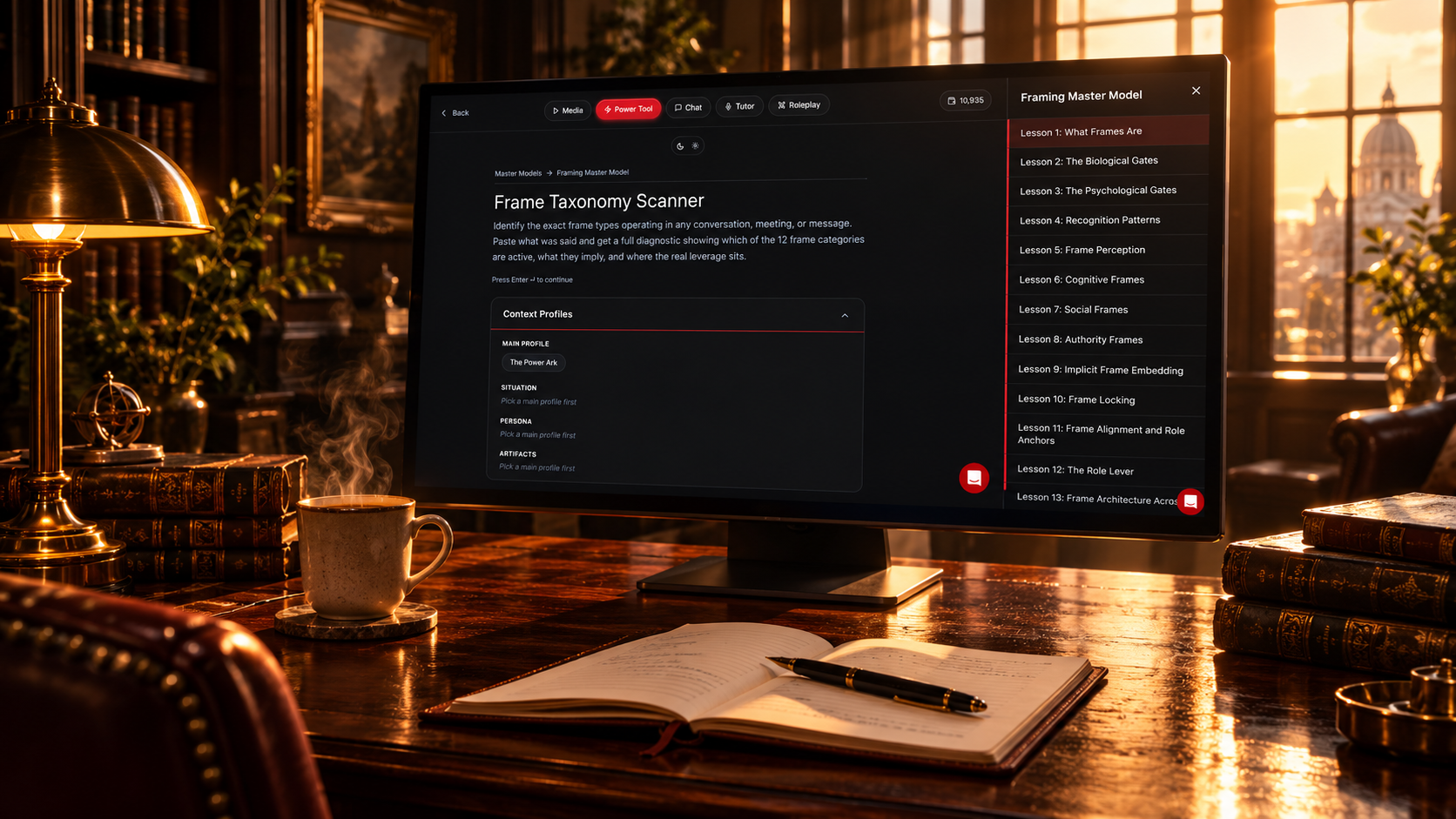
You Explain Your Business Once, And Every Agent In There Already Knows It
The first thing the platform does is not teach you anything.
It asks you about your work.
You hand it something to read. Your site, a page you paste in, a document you upload.
It reads that and comes back with what it has understood about your situation, offered as choices rather than empty boxes, so the job is correcting it rather than composing anything.
Then it asks about the situations you actually find yourself in, and the people you actually find yourself across from.
Five minutes, and you have a context profile.
That’s the piece nobody expects to matter, and it’s the reason none of this turns into homework.
Every AI in the platform reads it before it says a word to you.
You never open a tool by explaining who you are, what you sell, who you sell it to and what went wrong last time.
…It already has all of that.
Which is what makes iterating on something worth doing.
You run a law against your offer. You don’t like where it landed. You run it again with one thing changed, because the setup cost is zero every time after the first.
That’s the difference between a tool you use twice and a tool you actually work with.
And it isn’t per program. Build it once and it carries across everything you own in there, this model and whatever else you pick up later.
Then you’re into the model itself, one law at a time, in order.
Every law has its own page, and its four agents are sitting on it.
…The Power Tool, with your material already loaded.
…The Chat Guide.
…The Voice Tutor, with a call button.
…The Voice Roleplay, with a counterpart waiting.
Thirteen of those pages with the Core Model.
All thirty with the Master, because the Core sits inside it.
Fifty-two agents, or a hundred and twenty.
And 5,000 AI credits with the Core, 12,000 with the Master, so you can go and use the thing rather than ration it.
You explain your situation once, in the first five minutes. After that, nothing ever asks you again.

You Win More Of Them, And You Stop Discounting To Do It
Let me show you what an ordinary working week looks like once you’re the one setting the frame.
…This is the part nobody believes until it happens to them.
You’re writing something that matters. A proposal, a page, a note to somebody who could change your year.
And instead of trying to make it sound good, you work out first what they have to already accept for your point to be obvious, and you put that in front of them before you make the point.
…The writing takes about half as long, because you’re not arguing anybody into anything.
You get on a call you’d previously have been slightly tight about. Ninety seconds in, what it’s about has been settled, and it’s the thing you wanted it to be about.
Nobody pushed. There was nothing to push.
The number comes up and you say it plainly.
And you don’t talk after it.
You’ve watched yourself fill that silence for twenty years and this time you don’t, because you already set what they’re measuring it against.
They say yes.
Not an excited yes. A calm one.
…Those are the ones that don’t come apart two weeks later.
And here’s where it starts running on its own.
Which means you stop discounting, because you stop needing the yes badly enough to buy it.
Which means your average sale goes up without you changing a word of what you sell.
Which means you need fewer of them, so you can be more selective about who you take.
Which means the work itself gets better, because the people are better.
Which means the next conversation is easier still, because you’re walking in from a stronger place than you were last year.
That’s the part nobody tells you about a skill that sits underneath everything else.
It compounds in your favour instead of costing you every time.
And the ones you lose, you’ll know why.
And that is worth real money, because a loss you can explain is a loss you only take once. Forty-five years in, I still think it’s one of the better feelings there is: to lose one, know exactly which part of the setup failed, and fix that part before the next one.
You win more of them, you stop discounting to do it, and the few you still lose you can finally explain.

The Hand Is The Part That Can Be Taught
Go back to that auction one last time.
The violin never changed.
…Nobody sanded it.
…Nobody restrung it.
…Nobody talked the crowd into anything.
It sat there battered and scarred and worth three dollars, and then it was worth three thousand, and the only thing that happened in between was that somebody who understood what it was picked it up.
Nobody in that hall got smarter in those ten minutes.
…They were shown what they were actually looking at.
You already know what your version of that violin is.
It’s the thing you’ve spent years making good, that you can’t get people to hear properly, that you’ve watched lose to worse work described better.
And you’ve been standing where the auctioneer stood the whole time.
Not because you’re careless. Because nobody can hear their own work the way a stranger hears it, and because until now there was no method for the part that happens before you open your mouth.
There is now.
Every law, in order, with something to practise against, in a place you can open tonight.
So here’s where you are.
…You have a choice, and it’s the only one on the table.
You can go back to work tomorrow and keep arriving second, and keep losing the ones you can’t explain, and keep looking in the same four places.
…Or you can put yourself first.
I can’t make that call for you.
What I can do is teach you the part nobody ever taught me.
See that button?
Click it and you pick one of the two models.
…You answer a few questions about your work, which takes about five minutes.
…Then the first law opens, and the four AI agents on it already have your material loaded.
You’re not deciding whether any of this is real.
…You watched it take a violin from three dollars to three thousand in ten minutes, in front of a hall full of people who walked in to buy something else.
You’re deciding two things, and they’re both small.
Which of the two models you want.
And whether you start tonight, or spend another year looking in the same four places.
Open the first law tonight and run it against the one piece of your own material you’ve never been able to get people to hear.
You’ll know inside an hour whether I’m right.
It took me forty-five years to work this out, and most of that was slow because there was nobody to ask and nothing written down.
…That’s the part I can spare you.
Everything I found is in there, in order, with me walking you through every law and something to practise it on the same night you learn it.
That’s the master’s hand, and I’m holding it out to you.
…It was never talent. It’s knowing the laws well enough to stop having to think about them, and that comes from being shown them by somebody who already does.
Pick your model, click the button, and open the first law tonight.
Pick your model
Both open inside The Power Ark tonight.